- Case Study
- Architecture
- Security
- ·
-
Jan 13, 2026
The Terminal Protocol: Architectural Resilience Against Corporate Inertia
How I transformed a 17-year-old legacy infrastructure into a high-security cloud architecture single-handedly—and convinced the corporate auditors in the process.
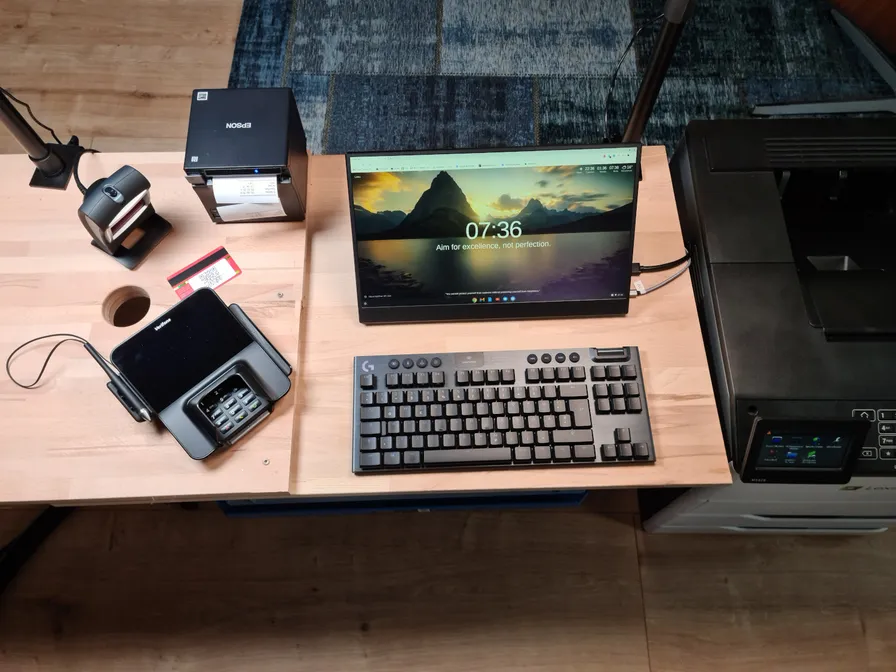
The Terminal Protocol: How I Saved a Critical Infrastructure from Standstill
In January 2020, I stood before the ruins of a digital strategy. I was brought in as a project coordinator to modernize the Point-of-Sale (POS) infrastructure of a leading European transport group. The scenario was an architect’s nightmare: no team, no defined goal, but an unyielding deadline.
In less than three years, the operating system of our service terminals would reach its end-of-life. Without security updates, hundreds of our most critical sales hubs—part of the country’s critical infrastructure—would be forced to close. This wasn’t just a software issue; it was a fundamental transformation of how hardware communicates.
The Architecture of Autonomy
The existing solution was a 17-year-old monolith. Devices like card terminals and printers were connected locally via USB, creating a rigid, brittle environment. My vision was radical: we would dissolve this physical coupling. Every device was to be natively integrated into the network, controlled via microservices in a cloud environment.
When the pandemic forced the world into home offices, the already sluggish recruitment process for a new team collapsed. Rather than waiting for the bureaucracy to provide me with staff, I began alone. I designed the architecture, wrote the first prototypes, and evaluated the hardware for the Europe-wide tender. I was the architect, technical project lead, and sole developer all in one.
Cryptographic Elegance vs. Human Error
A central problem was security. We were talking about thousands of devices communicating over Wi-Fi. IT Security demanded absolute password integrity, yet the technicians on-site—often external contractors—could never be allowed access to these sensitive credentials.
I developed an automated credential injection process that functioned without human interaction. Using a modified device firmware, we employed asymmetric encryption:
- The device generated a public key.
- My system encrypted the unique Wi-Fi credentials with it.
- The encrypted payload was sent back to the terminal.
Even the technician holding the device had no idea how it was authenticating. It was a closed loop of code and cryptography.
The Battle for the Millimeter
Technology often fails when it meets the reality of hardware. Our new network printers had to print tickets with sub-millimeter precision onto over 100 different, often non-standardized templates. Standard drivers failed miserably because they centered the print images, shifting the entire layout.
I spent weeks manipulating the PDF generation to trick the mechanical tolerances of the printers. I simulated incorrect page sizes to bypass the hardware’s internal centering logic. It was meticulous work that proved software architecture only truly shines when it understands and compensates for the imperfections of the physical world.
The Interrogation and the Breakthrough
Success eventually piqued the suspicion of the Corporate Audit department. As the budget rose due to massive technical expansions, I had to face a multi-day “interrogation.” Every architectural decision was dissected. Why cloud? Why this onboarding process? Why this encryption?
I held my ground. I could justify every line of code and every strategic pivot. My pride lay not just in the technology, but in the resilience of the system. I even redesigned the onboarding system for external technicians to run through a secured proxy in the DMZ—a masterpiece of security that delighted the CISO and finally made the rollout possible.
The Result: Stability in the Storm
Today, the system serves as the backbone of the sales hubs. The auditors eventually concluded: “Excellent work, stable and secure.”
Later, I visited the service hubs incognito. I didn’t just want to see the dashboards; I wanted to see reality. I watched as the terminals remained stable even during electromagnetic interference from passing high-speed trains. I saw employees serving customers without a single technical hurdle. The system had become invisible—the greatest compliment for any architecture.
I began the project with a “bus factor” of one. When I handed it over, it was a scalable, team-supported ecosystem.
The Tech Stack: Architecture of Resilience
To steer a project of this magnitude safely to its destination, I utilized a robust, modern toolset:
Infrastructure & Orchestration
- Kubernetes (EKS): The core for scaling and managing microservices.
- Docker: Containerization for consistent environments across all hubs.
- AWS: Cloud infrastructure for maximum high availability and security.
DevOps & Automation
- Helm 3 & Flux: GitOps-driven deployments for an automated CI/CD pipeline.
- SOPS: High-security encryption of secrets and credentials within the Git repository.
Backend & Interfaces
- Microservices Architecture: Decentralized control of specific hardware components.
- Redis: Message broker and state store for the secure onboarding process.
- Websockets: Real-time communication between POS terminals and employee interfaces.
- NGINX Ingress: Sticky sessions for stateful, multi-step payment transactions.
Protocols & Hardware Control
- ZVT Protocol: Custom implementation of the payment transaction stack including mock testing.
- IPP & CUPS: Network print control under Linux.
- Cisco ISE Proxy: Custom security concept for controlled network access of thousands of devices.
Frontend & OS
- Vue.js: Intuitive admin UI to manage complex device mapping and monitoring.
- Linux Thin Clients: Migration away from legacy Windows to a lean, low-maintenance hardware base.
Are you looking for an architect who doesn’t just write concepts but implements them technologically to the last mile? Let’s talk about how I can modernize your critical infrastructure.
Ready to improve developer productivity?
Let’s discuss how I can help your team reduce friction, improve delivery performance, and establish a measurable, stable development workflow. All services are available in German and English.